Published
Lorenzoz Agency launches its website on Next.js 16

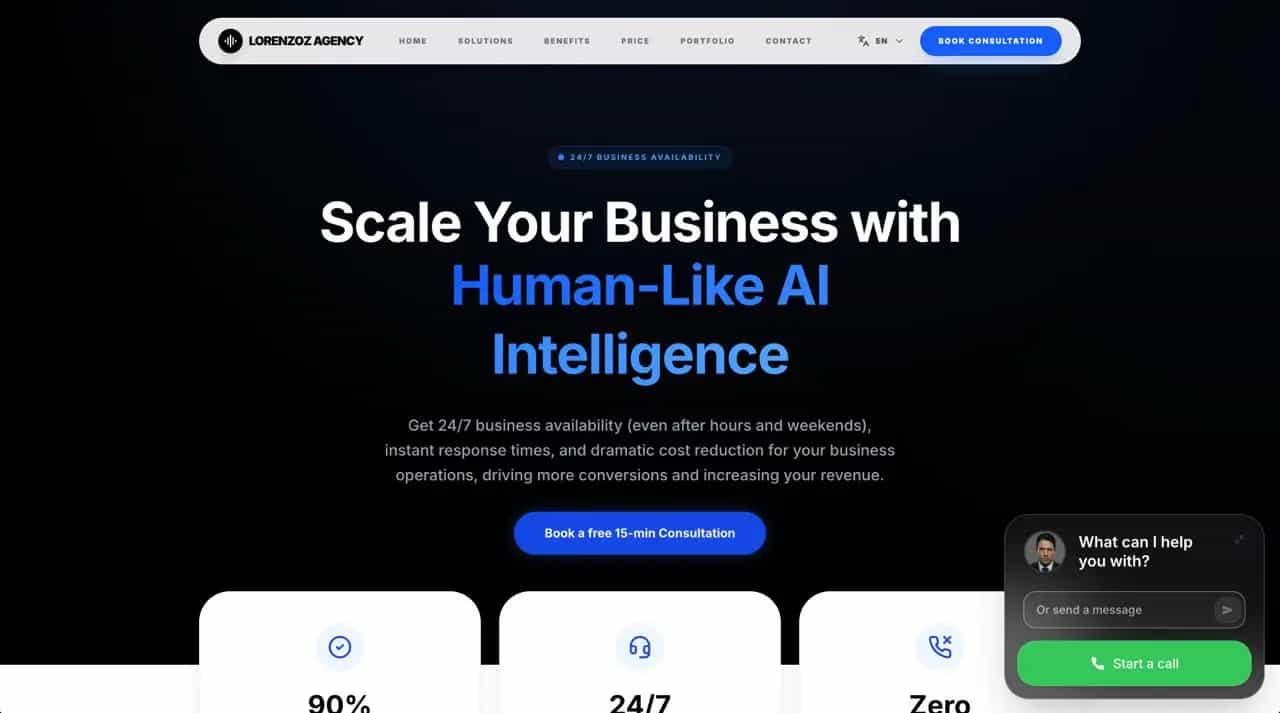
Lorenzoz Agency now has a home of its own on the web. This is the site where a business owner first meets us, sees what we offer and books a free 15 minute consultation, so we built it to the standard we promise our clients: fast on a phone, written in two languages, readable for search engines and checked by automated tests before every release.
This article explains how the site was built and launched in the first week of April 2026: the framework, the design, the way it is published, the tests that guard it and what we could verify at launch. Every result quoted below comes from a report or a test run of that week, with its date.
What the site offers at launch
The launch version leads with our AI voice service. The headline on the home page promises to scale a business with AI that sounds human, and the copy under it explains the benefit in plain terms: the business is available 24/7, including after hours and at weekends, and its customers get an answer at once. A single call to action invites the visitor to book a free 15 minute consultation, and the navigation covers solutions, benefits, prices, the portfolio and contact.
The service is also on the page itself. A voice assistant built with ElevenLabs sits in the corner of every page, where a visitor can type a question or start a call and talk to it. It is the most direct demonstration we could give of the product we sell: before booking anything, a visitor can hear how an AI receptionist answers.
Around the home page, the launch includes a portfolio with concept projects for a dental clinic, a luxury real estate agency and a fitness studio, each with its own detail page in English and Spanish, a digital business card, and the privacy policy, cookie policy and terms and conditions. The picture at the top of this article is the home page as it looked at launch.
Built on Next.js 16 and Tailwind CSS 4

The site is a Next.js 16 project, the React framework, styled with Tailwind CSS 4. Bun installs the dependencies and runs every script, from the linter to the tests, which keeps local work and the automated pipeline on the same commands.
Next.js builds the whole site ahead of time as a static export. Every page becomes a finished HTML file in an output folder, and nothing has to be generated on a server when a visitor arrives. A marketing site only changes when we publish, not when someone opens it, so there is no reason to run a server for each request: the files are ready, and the network only has to deliver them.
The illustration sums up the stack at launch: Next.js 16 and Tailwind CSS 4 for the site, Cloudflare as the edge network that hosts it, GitHub Actions for continuous integration, Vitest for unit tests and Playwright for end to end tests in real browsers.
A glass design that holds on every screen
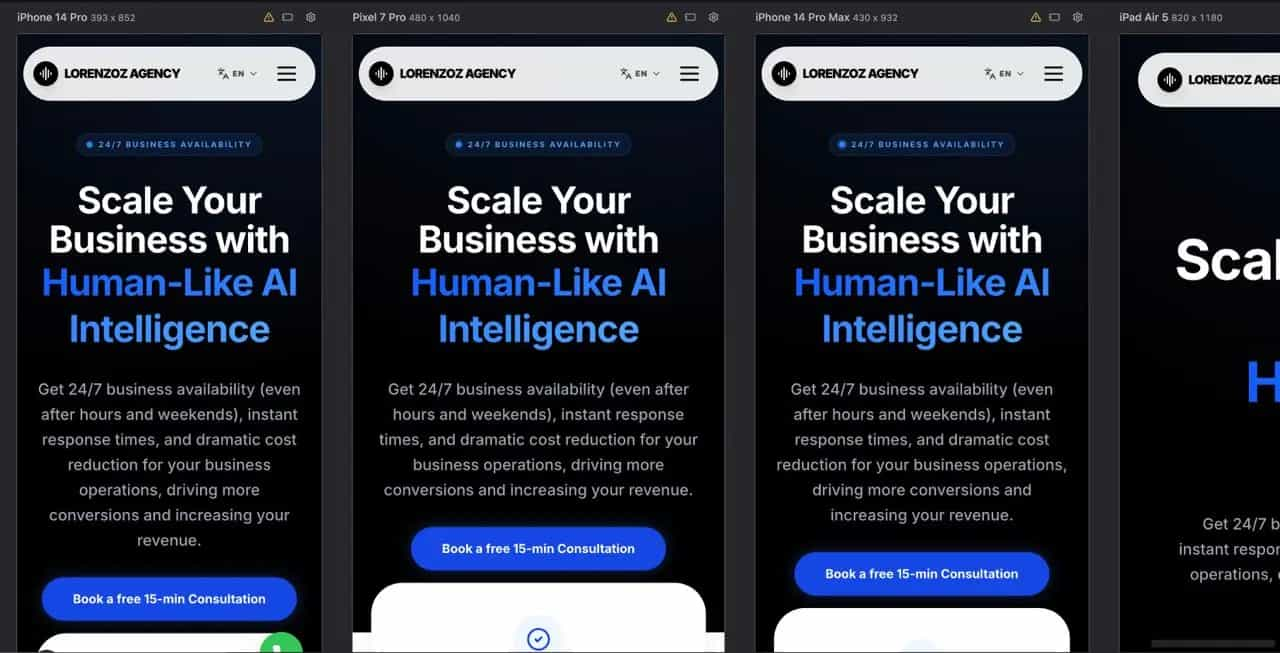
The visual identity is a glassmorphism design: a dark hero, a frosted navigation bar that floats above the content, translucent cards and a bright brand blue for the actions that matter. The same tokens drive every page, so the portfolio, the legal pages and the business card all read as one site.
Most visitors to a local business arrive on a phone, so the layouts were checked in the browser at the sizes of an iPhone 14 Pro (393 by 852 pixels), a Pixel 7 Pro (480 by 1040), an iPhone 14 Pro Max (430 by 932) and an iPad Air 5 (820 by 1180). The screenshot shows the same hero on all four: the headline, the copy and the booking button reflow to the width of the screen without being cut or overlapping.
On small screens the menu folds behind a single button, while the logo and the language selector stay visible at the top, so switching between English and Spanish never takes more than one tap.
Two languages from day one
Every page exists in English and in Spanish under its own address, with the language as the first part of the path. Translations live in one message file per language and are loaded by a translation library made for Next.js, so a page is written once and filled with the text of the language the visitor chose.
Both versions are written natively, not passed through a translator. The automated tests open the English and Spanish versions of the home page and of the portfolio detail pages, and check that the language switch takes the visitor to the same page in the other language.
Published as static files on Cloudflare
Because the build is a folder of plain files, publishing is a copy: the last step of the pipeline uploads the static export to Cloudflare, which serves it from its network close to each visitor. Images are delivered through the Cloudflare CDN rather than from the site build.
This setup has very little that can break. There is no server process to keep up to date, no database to fill or to lose, and no code running for each visit, so a sudden spike in traffic only means more files delivered from a cache. Hosting costs stay low for the same reason.
Every push goes through a pipeline
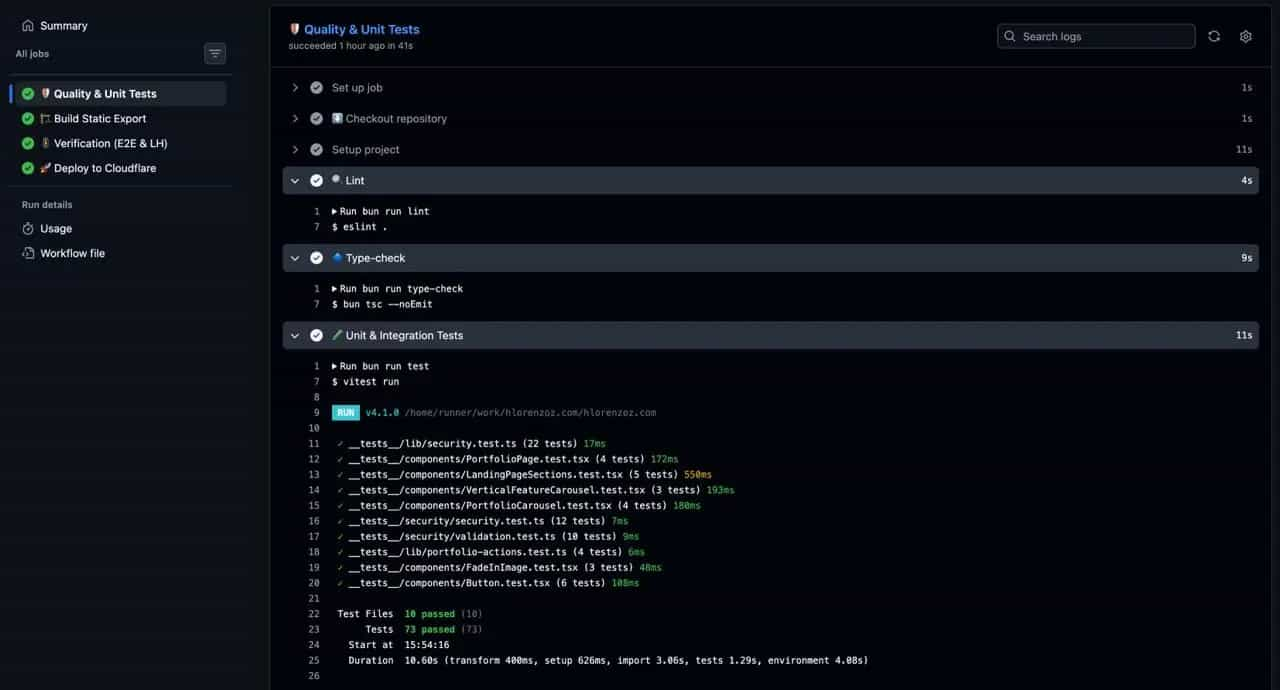
The repository runs a GitHub Actions pipeline on every push and pull request. It has four jobs in a fixed order, and each one waits for the previous one to pass: quality checks and unit tests, the build of the static export, verification with end to end tests and Lighthouse, and the deploy to Cloudflare. A change that fails at any step never reaches the live site.
The quality job runs ESLint, a TypeScript type check and the unit tests in Vitest 4.1.0. In the run shown, 10 test files and 73 tests passed in about 11 seconds. They cover the security and input validation helpers, the portfolio data and components such as the carousels, the image that fades in on load and the buttons.
Before code even reaches the pipeline, pre commit hooks run on the developer's machine with Bun, so most mistakes are caught locally in seconds instead of minutes later in the pipeline.
End to end tests in five browsers
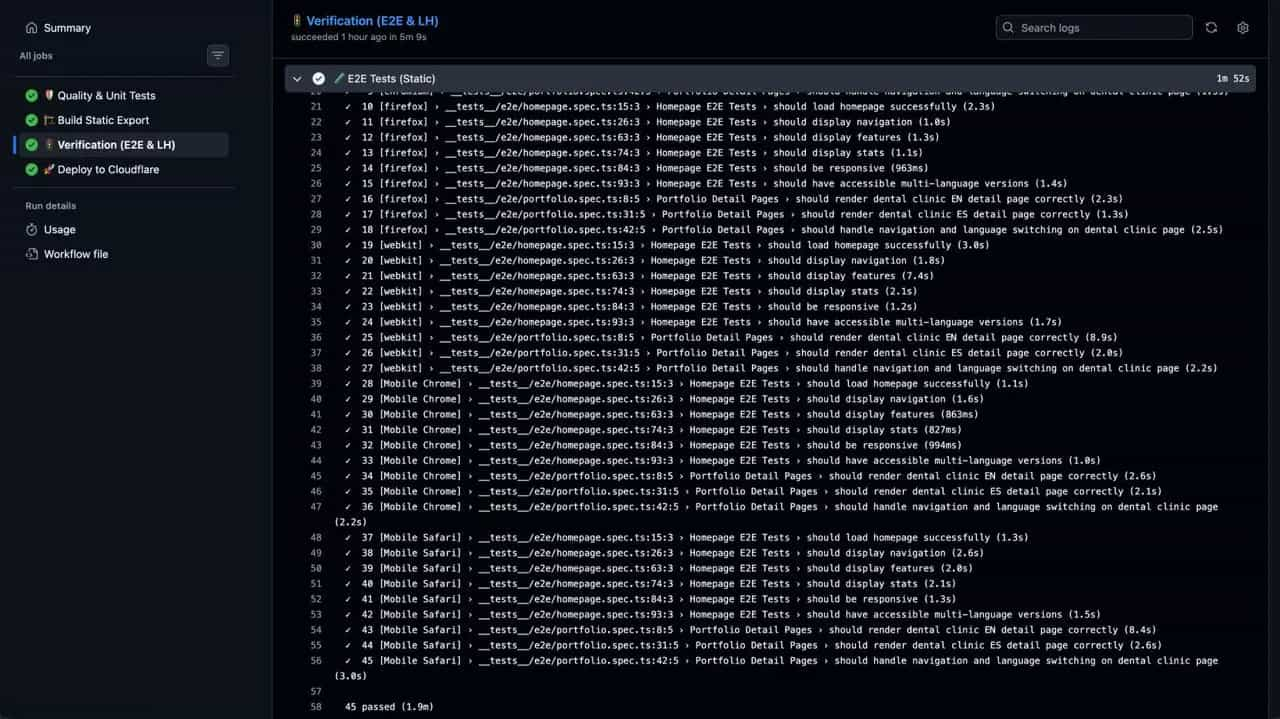
The verification job tests the static export itself, the same files that are about to be deployed. Playwright opens the site in five browser profiles: Chromium, Firefox and WebKit on desktop, plus Mobile Chrome and Mobile Safari.
Each profile runs the same nine scenarios. On the home page the tests check that it loads, that the navigation works, that the features and the stats are shown, that the layout responds to the screen size and that both language versions are accessible. On the dental clinic case study they check the English and the Spanish detail pages and the switch between them. In the run of April 6, 2026 all 45 tests passed in 1.9 minutes.
Lighthouse audits in the same run
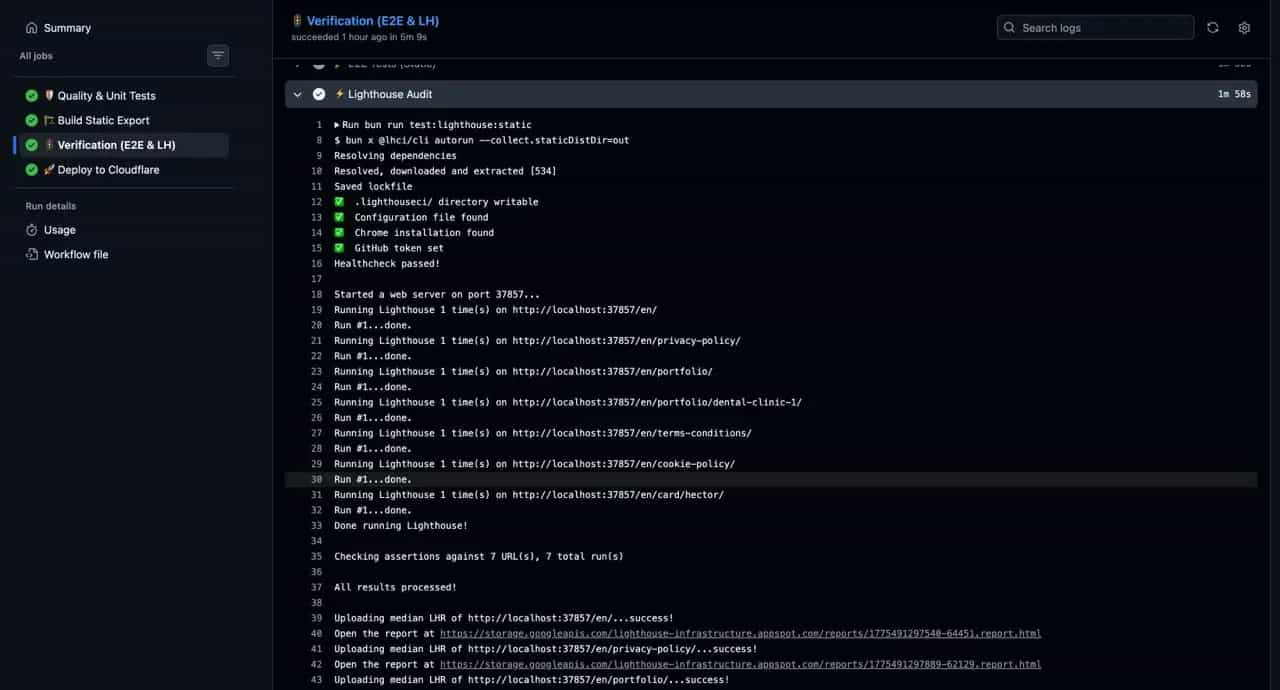
In the same job, Lighthouse CI serves the static export on a local server and audits seven pages: the English home page, the portfolio, the dental clinic case study, the digital business card and the three legal pages. The results are checked against the assertions set for the project, and the job only passes if they hold.
The run in the screenshot passed and uploaded its reports on April 6, 2026. We do not quote scores from it here, because the log shows the audits passing rather than the individual numbers. What it shows is the habit that matters: performance, accessibility and SEO are checked on every change, not once before launch.
Structured data recognised by Google
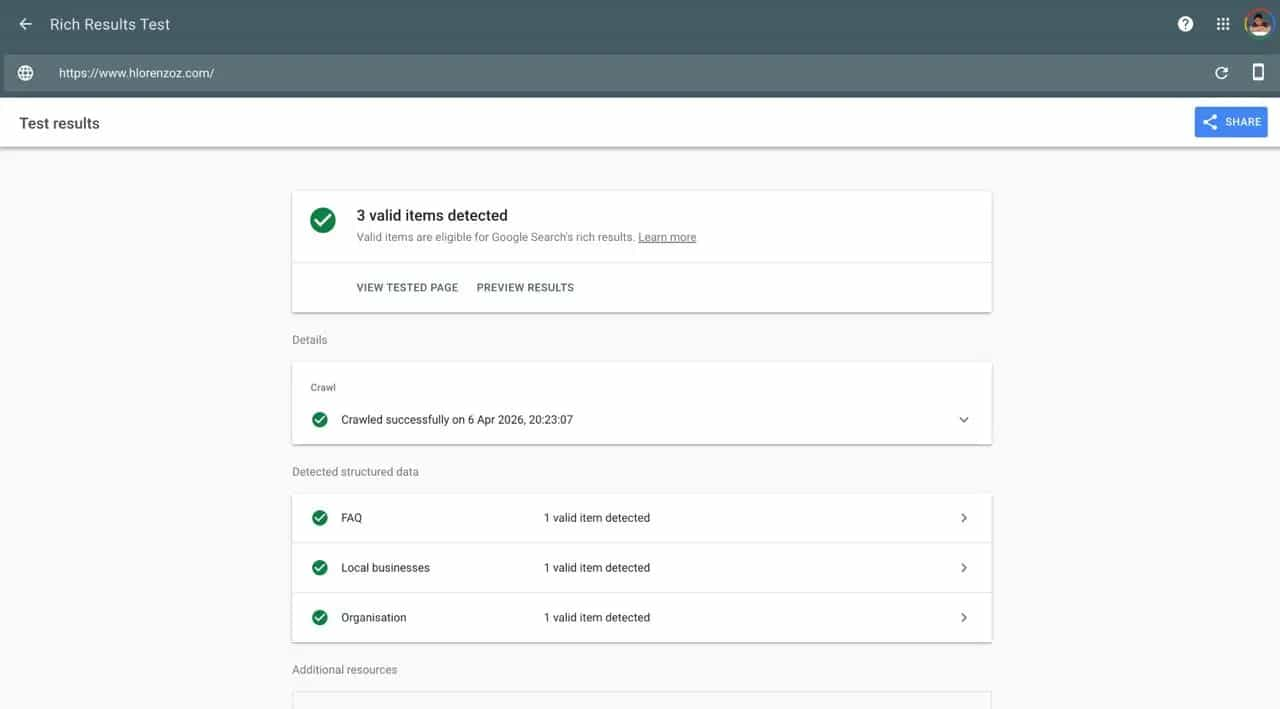
Search engines and AI assistants read a page more reliably when it describes itself in structured data. The home page carries JSON-LD that presents the agency as an organisation and a local business and publishes its frequently asked questions in a form Google can read.
On April 6, 2026 at 20:23, Google's Rich Results Test crawled the home page and found three valid items: FAQ, Local businesses and Organisation. Valid items make the page eligible for rich results in Google Search. The screenshot is that report.
What a local business can take from it
Everything above is the standard we offer to clients. A static site served from the edge loads quickly on the mobile connections most local customers use, costs little to host and has very little that can go down. Two native language versions reach both audiences. Structured data tells Google who the business is and what it offers without guessing, and a pipeline of tests means a broken page is caught before a customer sees it.
None of this guarantees a position in Google, and we never promise one. What it does is remove the technical reasons a good business gets passed over: slow pages, unreadable data and layouts that break on a phone.
What came next
In November 2026 we rebuilt the site on Astro, keeping the same addresses, design and content while sending far less JavaScript to the browser. A separate post covers that migration and its measured results.